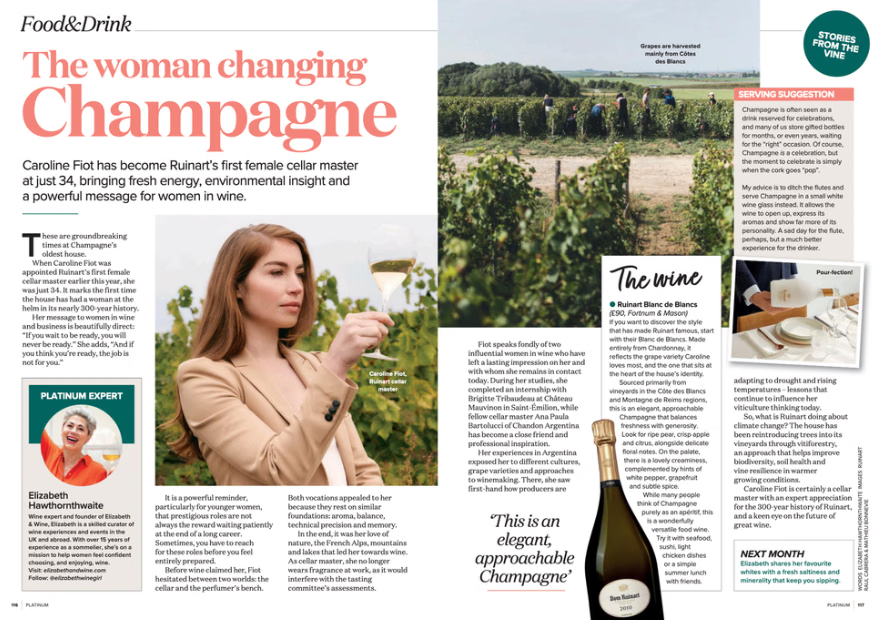
When Caroline Friot was appointed Ruinart's first female cellar master earlier this year, she was just 34. It marks the first time Ruinart has ever had a woman at the helm in its nearly 300 year history.
Her message to women in wine and in business is beautifully direct: "If you wait to be ready, you will never be ready." She adds, "And if you think you're ready, the job is not for you." What a powerful message, particularly for younger women: prestigious positions are not always just the reward at the very end of a long career. If you reach out and grab them, youth is no barrier.
Before wine claimed her, Friot hesitated between two worlds - the cellar and the perfumer's bench - drawn to both because they rest on the same foundations: aroma, balance, technical precision and memory.
In the end, it was a love of nature, the French Alps, mountains and lakes that led her towards wine. As a cellar master she no longer wears fragrance at work as it would interfere with the tasting committee's assessments.
Friot speaks fondly of two influential women in wine who have left a lasting impression on her and with whom she remains in contact today. During her studies, she completed an internship with Brigitte Tribaudeau at Château Mauvinon in Saint-Émilion, while fellow cellar master Anna Paola Bartolucci of Chandon Argentina has become a close friend and professional inspiration.
Friot's experiences in Argentina exposed her to different cultures, grape varieties and approaches to winemaking. There, she saw first-hand how producers are adapting to drought and rising temperatures, lessons that continue to influence her thinking today.
So what is Ruinart doing about climate change? The house has been reintroducing trees into its vineyards through vitiforestry, an approach that helps improve biodiversity, soil health and resilience in warmer growing conditions.
Champagne is often seen as a drink reserved for celebrations, and many people store gifted bottles for months or even years waiting for the "right" occasion. Of course, Champagne is a celebration, but the moment to celebrate is simply when the cork goes pop.
My advice is to ditch the flutes and serve Champagne in a small white wine glass instead. It allows the wine to open up, express its aromas and show far more of its personality. A sad day for the flute, perhaps, but a much better experience for the drinker.
Ruinart Blanc de Blancs
If you want to discover the style that has made Ruinart famous, start with Ruinart Blanc de Blancs. Made entirely from Chardonnay, it reflects the grape variety that Caroline Friot loves most and the one that sits at the heart of the house's identity.
Sourced primarily from vineyards in the Côte des Blancs and Montagne de Reims, this is an elegant, approachable Champagne that balances freshness with generosity. Look for ripe pear, crisp apple and citrus, alongside delicate floral notes. On the palate, there is a lovely creaminess complemented by hints of white pepper, grapefruit and subtle spice.
While many people think of Champagne purely as an aperitif, this is a wonderfully versatile food wine. Try it with seafood, sushi, light chicken dishes or a simple summer lunch with friends.
Elizabeth Hawthorthwaite, Platinum Magazine, October 2026