


Where Great Wine Meets Greater Women | Platinum Magazine
- Elizabeth Hawthornthwaite
- Feb 18
- 4 min read
Updated: Jul 17
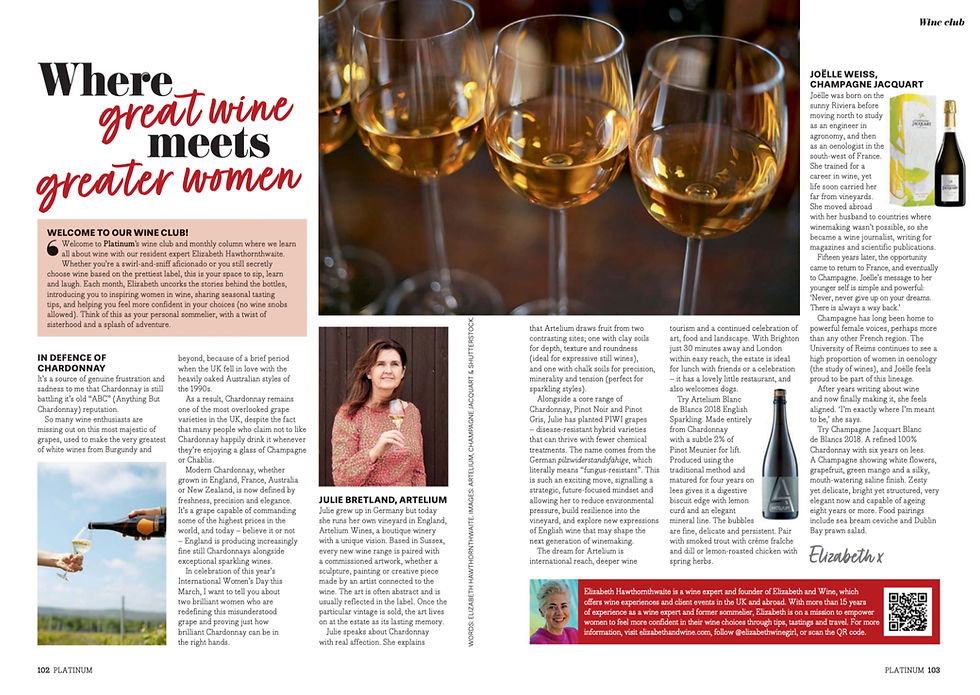
The subject of women in wine has always fascinated me. Like many industries, the wine world was traditionally male-dominated, but this has changed dramatically in recent decades. Today, some of the most exciting wines in the world are being made by female winemakers, whose perspectives, creativity, and commitment to sustainability are shaping the future of the industry.
When you open a bottle of wine, it’s easy to focus on the flavours in the glass. But behind every wine is a person, a vineyard, and a story. Increasingly, those stories belong to talented women redefining modern winemaking.
For centuries, the wine industry operated largely as a family business, and in many regions, inheritance traditionally passed to male children. This created a culture where women were often discouraged from becoming winemakers. Many were told that their place was in administration, marketing, or hospitality rather than the cellar.
Historically, attitudes toward women and alcohol were even more extreme. In 190 BC, Roman law permitted a husband to divorce or even kill his wife if she was caught drinking wine. In later centuries across Europe, women were frequently banned from taverns while men gathered freely to drink and socialise.
Although the industry has evolved significantly, traces of these outdated myths still linger. One long-standing superstition suggested that a menstruating woman entering a wine cellar could cause the wine to spoil or turn into vinegar. It may sound unbelievable today, but comments like this have reportedly been made to leading English winemakers even in recent years.
The irony is that on the consumption side of the wine industry, women dominate. Research consistently shows that women buy more wine than men and spend more on it, particularly when it comes to Champagne, one of the world’s most iconic celebratory drinks.
So an interesting question arises: do women make wine differently?
Many believe they do. Female winemakers often speak passionately about sustainability, environmental responsibility, and the long-term health of their vineyards. Their approach frequently emphasises balance, precision, and a deep sense of place.
Renowned wine writer Jancis Robinson has suggested that women often demonstrate a heightened tasting sensitivity. This ability to detect subtle flavours and aromas can influence the smallest details in winemaking decisions, shaping wines that feel refined, expressive, and elegant.
To celebrate International Women’s Day, I’d like to highlight two inspiring women who are redefining one of the world’s most misunderstood grape varieties: Chardonnay.
Artelium Blanc de Blancs 2018 Julie Cope | Sussex, England
Julie Cope grew up in Germany but now runs Artelium Wines, a boutique English winery located in Sussex, one of the most exciting regions for English sparkling wine.
Artelium stands out for its creative approach. Each wine release is paired with a commissioned artwork, whether a sculpture or painting. Once the vintage sells out, the artwork remains on the estate as a lasting tribute to that year’s harvest.
Julie sources Chardonnay fruit from two contrasting vineyard sites. One site features clay soils that produce depth and richness, ideal for expressive still wines. The other sits on chalk soils, bringing precision and minerality — the perfect foundation for traditional method sparkling wine.
Julie is also focused on the future of sustainable viticulture. She has planted PIWI grape varieties, which are naturally disease-resistant hybrids that require significantly fewer chemical treatments. The name comes from the German pilzwiderstandsfähige, meaning “fungus-resistant”, and represents an innovative step toward more resilient vineyards.
Artelium Blanc de Blancs 2018 English Sparkling Wine
Made primarily from Chardonnay with a small touch of Pinot Meunier, this elegant sparkling wine spent four years ageing on its lees. The result is beautifully layered, with notes of lemon curd, toasted biscuit, and a fresh mineral finish.
Champagne Jacquart Blanc de Blancs 2018 Joëlle Weiss | Champagne, France
Joëlle Weiss grew up on the French Riviera and initially trained as an agronomy engineer before becoming an oenologist in south-west France.
Her career then took an unexpected turn when she moved abroad with her husband to countries where winemaking wasn’t possible. During that time, she became involved in wine journalism, maintaining her connection to the industry.
Fifteen years later, an opportunity emerged to return to France and eventually work in Champagne, one of the most prestigious wine regions in the world.
Joëlle’s advice to her younger self is simple but powerful:
“Never give up on your dreams. There is always a way back.”
Champagne has historically been home to a strong community of female winemakers and wine professionals, and Joëlle is proud to contribute to this evolving tradition.
Champagne Jacquart Blanc de Blancs 2018
Made from 100% Chardonnay and aged for six years on its lees, this elegant Champagne reveals aromas of white flowers, grapefruit, and green mango. The palate finishes with a delicate saline freshness that makes it incredibly food-friendly.
This Champagne drinks beautifully now but also has the structure to age for eight years or more.
Perfect pairing: sea bream ceviche or a Dublin Bay prawn salad.
Despite technological advances in modern winemaking, the wine industry remains deeply human. Every bottle reflects the decisions, experiences, and philosophies of the person who made it.
Today, female winemakers are transforming the industry, bringing new ideas around sustainability, creativity, and terroir-driven wines.
So next time you open a bottle, take a moment to think about the person behind it.
She just might be one of the remarkable women redefining the world of wine.
Elizabeth Hawthorthwaite Written for Platinum Mgazine, March 2026


Comments